
Hypsizygus tessulatus
aka. Shimeji
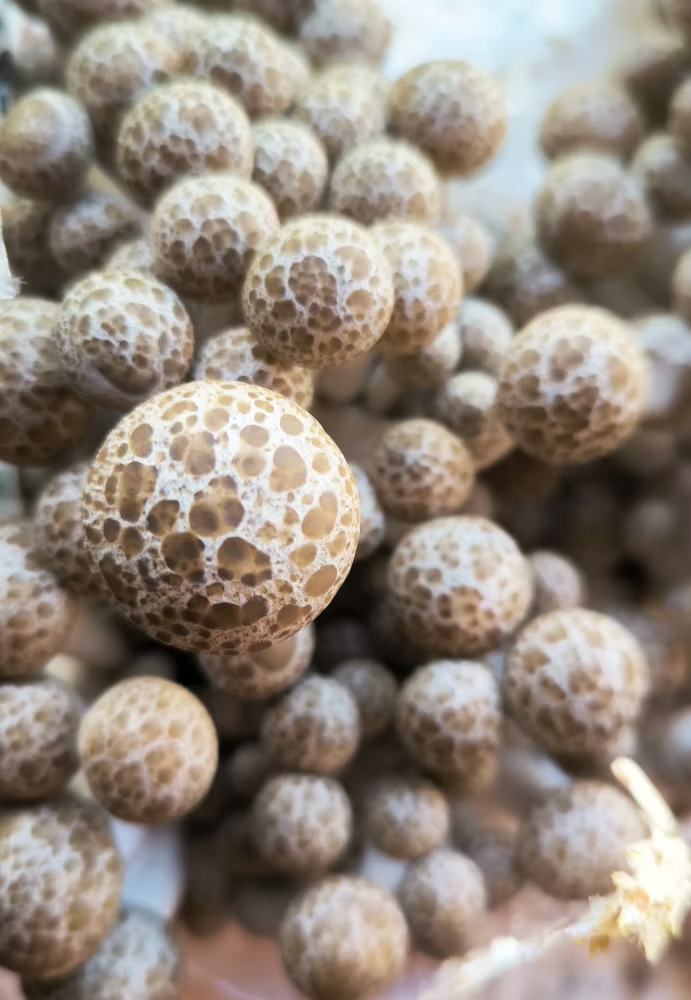
Hypsizygus tessulatus is a jewel of Asian mycology and one of the most highly prized mushrooms among gourmets. Best known by its Japanese name Shimeji or “Beech Mushroom“, this gregarious mushroom grows in beautiful, dense clusters. In Japan, a famous culinary proverb dictates: “Matsutake for fragrance, Shimeji for flavor”! Today, it comes in two star varieties on market stalls: the Buna-shimeji, with its pretty marbled brown cap, and the Bunapi-shimeji, a pristine white version. With a firm texture and a nutty flavor, it has become a staple of both everyday cooking and haute cuisine.
History
Natural origin: Shimeji is a strictly lignicolous saprophytic mushroom. It grows naturally in the temperate regions of the Northern Hemisphere (East Asia, Northern Europe, and North America). It develops on dead or decaying wood of broadleaf trees, with a particular affinity for trees of the beech family (Fagus), from which it gets its vernacular name.
Earliest traces: Wild foraging of Shimeji is a millennia-old tradition in Japan, where it was harvested in the autumn in broadleaf forests. Its gastronomic reputation there has been immense for centuries, although its cultivation long remained impossible due to the complexity of replicating the conditions for cluster fruiting.
Present day: The modern history of Shimeji is inseparable from Japan. Its cultivation exploded in the 1970s thanks to the adaptation of the famous controlled-environment bottle cultivation technique. The great revolution occurred in the early 2000s: Japanese researchers selected and patented the Bunapi-shimeji (the white version), a mutation obtained to eliminate the natural bitterness of the raw mushroom and appeal to a wider audience, especially children. Today, both brown and white varieties are cultivated industrially worldwide on enriched sawdust substrates.
Nutritional Composition
Amino acids: Very rich in glutamic acid, aspartic acid, and guanylate, the magic trio responsible for its explosive umami taste.
Vitamins: Excellent vitamin B complex, notably B2 (riboflavin), B3 (niacin), B5 (pantothenic acid), B6, and D2 (precursor, increasing drastically after UV exposure).
Minerals and trace elements: Rich in potassium, phosphorus, zinc, iron, and copper.
Proteins: 15 to 20% (of dry weight, with excellent digestibility once cooked).
Polysaccharides: Significant fraction of beta-glucans (specifically beta-(1,3)-(1,6)-D-glucans) involved in immune support.
Phenolic derivatives and bioactive compounds: Phenolic acids, flavonoids, and L-ergothioneine (a powerful intracellular antioxidant).
Fiber: Approximately 30% of dry weight, promoting excellent intestinal transit and acting as prebiotics.
Sterols: Ergosterol, essential for the synthesis of vitamin D.
Culinary Delights
In the kitchen, Hypsizygus tessulatus is a formidable ally, but it has one golden rule: it must never be consumed raw! Raw, it has a pronounced bitterness and is indigestible. However, once cooked, the magic happens. The bitterness completely disappears, giving way to a mild, buttery nutty flavor and exceptional umami power. Shimeji (whether brown or white) retains a crisp, fleshy texture that never becomes slimy. Simply cut off the base of the cluster to release the small mushrooms, ready to be sautéed.
Recipes coming soon!
A few recipe variations
Garlic Butter Sautéed
Shimeji
Recipes coming soon!
Traditional Miso Soup
with Shimeji
Recipes coming soon!
Stir-fried Soba Noodles with
Beech Mushrooms
Recipes coming soon!
Mushroom Risotto with Two
Shimejis (Brown & White)
Recipes coming soon!
Shimeji Cluster
Tempura
Recipes coming soon!
Beef and Sesame
Shimeji Wok
Recipes coming soon!
Japanese Mushroom
Omelet
Recipes coming soon!
Creamy Mustard Chicken
with Shimeji
Recipes coming soon!
Rustic Toast with
Roasted Shimeji
Recipes coming soon!
Shimeji Pickles
in Rice Vinegar
Recipes coming soon!
Functional Properties and Well-being
Beyond its undeniable gastronomic qualities, Hypsizygus tessulatus proves to be a first-rate functional food, closely scrutinized by modern medical research. A true biochemical factory, it synthesizes an impressive diversity of secondary metabolites that actively support our metabolism. Whether it is regulating inflammation thanks to its richness in antioxidants, supporting the cardiovascular system, or stimulating our immune defenses (thanks to its highly bioavailable beta-glucans), this mushroom offers a synergy of active ingredients essential to our daily vitality. Note: in scientific literature, this mushroom is studied almost exclusively under its official taxonomic synonym, Hypsizygus marmoreus.
For the curious, here is the PubMed link compiling research on the subject:
Disclaimer:
It is important to remember that studies on the therapeutic properties of these mushrooms are still ongoing. The information contained on our website does not replace professional medical advice and should not be used to diagnose, treat, or prevent any diseases. Please consult a doctor before using Hypsizygus tessulatus/marmoreus for medicinal purposes. Furthermore, results may vary from person to person.